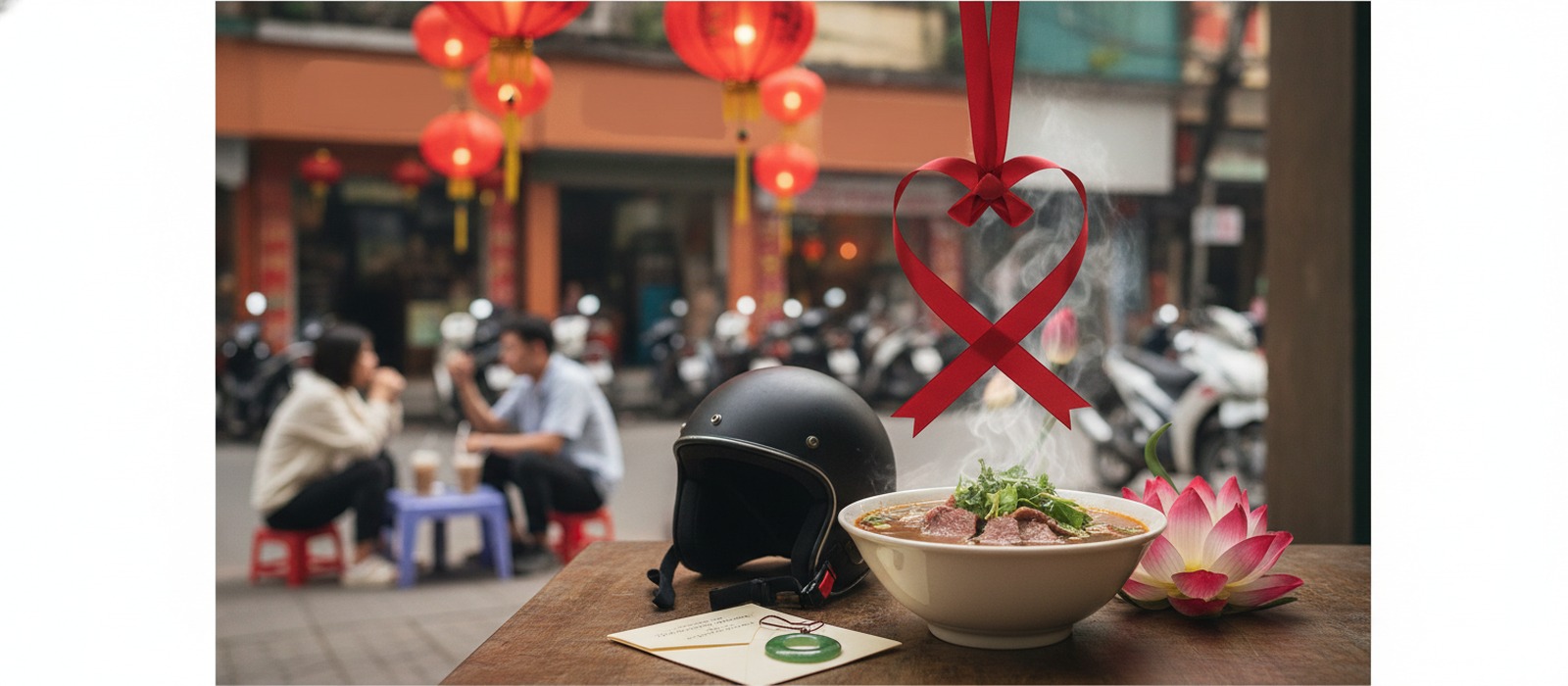
Vietnamese dating culture runs on rules that rarely make it into a phrasebook: who pays, who leads, who gets a say before you do. Get the sequence wrong and a promising conversation goes quiet within a day. This guide breaks down what actually happens between meeting someone and meeting her parents, the exact Vietnamese sentences for each moment, and what she is likely to say back.
- 🎯 He proposes, she decides, Vietnamese dating culture still expects you to suggest the plan, not ask "what do you want to do?"
- 💰 You pay, for a while, most sources agree the man covers the bill for the first several dates, sometimes longer.
- 👪 Family sits in on the relationship, a sister calling mid-date or a curfew text is normal, not a warning sign.
- 🗣️ The pronoun carries the meaning, using the wrong word for "you" can flatten an otherwise perfect sentence.
None of this works as a script you memorize and repeat to whoever is in front of you. It works because each sentence below is tied to a specific moment, and because the moment usually matters more than the words.
What Vietnamese Dating Culture Actually Expects From You
Vietnamese dating culture places the man in the role of the one who decides, and the family in the role of the one who watches. Two independent YouTube creators who cover expat dating in Vietnam, Viet Kieu Dating and Duong Global Business Consulting Group, both describe the same pattern from different angles: the man pays for the first dates, and the man proposes what happens next rather than asking her to choose.
Duong Global Business Consulting Group's video adds an important exception: a woman who studied or lived abroad, or one who is financially established herself, may insist on paying her own share or even the whole bill. The default still leans traditional, but it is not universal, and assuming otherwise with an independent, well-off woman can read as presumptuous rather than gallant.
It also helps to size up the pool honestly. In a joint interview on The Evan Eh! Show, a Canadian long-term resident and his single foreign friend Michael put the real number at around 85 to 90 percent of women in Ho Chi Minh City who have no interest in dating a foreigner at all, mostly because they do not speak English and are not part of the same social circles. The women you do end up meeting, Michael argues, are self-selected: already curious about the West, often already learning English, sometimes already having dated a foreigner before. That changes what "traditional" means in practice, since the woman in front of you is rarely the most conservative option in the room.
Writer Cameron Shingleton, in a 2015 essay on Medium, frames this as a full life pattern rather than a dating quirk: a traditional Vietnamese wife may hand her husband's earnings back to him as a small allowance while she manages the household budget. Paying on early dates, in that reading, is the opening move of a much longer financial arrangement, not a one-off gesture.
Why does the man have to lead every decision?
Indecision reads as weakness in this context, not humility. Viet Kieu Dating's video is blunt about it: asking "where do you want to go, what do you want to eat" repeatedly signals that you cannot be trusted to plan, and Vietnamese women, per that channel, tend to disengage from men who cannot commit to a direction. The workable middle ground both videos describe is to propose a specific plan and stay open to her adjusting it, rather than either dictating everything or outsourcing every choice to her.
Public affection tightens the same expectation. Viet Kieu Dating and VnExpress both note that kissing or hugging in public is read locally as a lack of respect for the woman, not romance. VnExpress reported in August 2024 on Joe, a foreign resident of six years in Ho Chi Minh City, whose girlfriend's parents enforced a 9 p.m. curfew and repeatedly called her during their date, precisely the kind of family oversight that surprises men who assume dating is a private matter between two adults.
How to Introduce Yourself Without Sounding Like a Phrasebook
The moment that matters here is the first real conversation, whether it starts at a coffee shop, a gym, or right after an app match turns into an in-person coffee. A user on r/DaNang who posted an AMA about dating local Vietnamese women, an American expat with a following of over 58,000 subscribers on YouTube, describes this exact sequence: match on an app, agree to a simple coffee, and use that first meeting to see if she is genuinely interested before suggesting anything bigger.
If she has taken a seat near you and glanced over, or the coffee date is already arranged and you are simply opening the conversation, a natural line is Chào em, anh ngồi đây được không? ("Hi, can I sit here?"), pronounced roughly "chow em, ang ngoy day duhk khom." Use anh for yourself and em for her if you are the same age or older, which covers most foreign-Vietnamese pairings; if she is clearly older than you, swap to em for yourself and chị for her. Getting this pronoun backward is a small grammar error that reads as a bigger one: it can sound like you are talking to a child, or that you do not know basic manners.
What if she's shy and won't make the first move?
Expect her to wait for you to lead, even if she is interested. A Singaporean woman posting in r/VietNam described the reverse case clearly: dating a shy man from Hanoi, she had to take the lead on texting and planning herself, because he would not initiate. Several commenters treated this as consistent with how many Vietnamese men are raised, and the same reticence shows up in women too, particularly outside the largest cities.
Skin tone can also shape how quickly someone opens up. A mixed-race Englishman planning to move to Hanoi asked r/VietNam directly about dating as a person of color there, noting that beauty standards in the north still favor lighter skin. That kind of hesitation is not personal rejection; it is a cultural bias worth knowing about before you read silence as disinterest. If your Vietnamese is still limited to a handful of set phrases, our guide to basic Vietnamese phrases for actually talking to her covers the next layer beyond a first hello, and how to say hello in Vietnamese if you want the opening line itself to sound native rather than textbook.
Asking Her Out and Reading Her Answer
Once you have exchanged a few messages, usually on Zalo, the Vietnamese messaging app that functions the way WhatsApp does elsewhere, the next moment is proposing a specific date rather than a vague "let's hang out sometime." A workable line is Cuối tuần này em có rảnh không? ("Are you free this weekend?"), pronounced "kwoy-tune nay em koh zahn khom." Again, anh for yourself if you are the same age or older, em for her.
What she says back carries more information than the words alone suggest, and reading it correctly is as important as the sentence itself. Expat.com notes that a friend joining the date, especially early on, is common and is about safety and comfort rather than a lack of interest in you specifically.
| What she says or does | What it usually means | What to do |
|---|---|---|
| "Dạ có" (yes) right away | Genuine interest, low hesitation | Confirm a time and place immediately |
| Short, delayed replies | Shy, or testing your patience | Wait, do not send a second message asking why |
| Asks to bring a friend | Normal safety norm, not rejection | Agree, treat it as a group hangout |
| "Để em hỏi ba mẹ" (let me ask my parents) | Family is part of the decision | Respect the delay, do not push |
| No reply for over a day | Likely a soft no | Move on, do not chase |
SOURCE: creator transcripts and Reddit threads cited above · Updated 09/2026
What does it mean when she doesn't reply right away?
A delayed reply is more often caution than disinterest. The r/DaNang AMA poster, who says he has dated many local women in Da Nang, frames the first coffee itself as the real test: if she agrees to something as simple as coffee rather than pushing for an expensive restaurant, that is a stronger signal than how fast she texts back. Silence after you ask for her number, though, is a different signal, and both dating-focused channels cited here treat it as a soft decline rather than something to follow up on twice.
If you are meeting people primarily through apps rather than in person, which is the norm in several Vietnamese cities according to a video filmed in Da Nang by Esq Unltd Daily, our breakdown of dating apps in Vietnam covers which platforms actually get used locally versus which ones mostly attract tourists.
What Changes Once Her Family Gets Involved
Family involvement in Vietnamese dating culture is not a phase that ends after the first few dates: it tends to deepen. A Reddit user in r/VietNam described his Vietnamese girlfriend's sister calling repeatedly throughout an entire visit, from airport pickup to departure, and being told this was completely normal, not a boundary problem to raise with her.
Duong Global Business Consulting Group's video describes a specific test parents run at a family dinner: they insist on paying the bill, sometimes three times in a row, and a foreign boyfriend who keeps insisting back, "no, I will take care of that," earns real credibility as someone financially stable and serious. Backing down and letting them pay reads the opposite way. The same video also flags that checking a partner's phone, including messaging and social media passwords, is treated as normal in many Vietnamese relationships rather than as controlling behavior, a point worth knowing before you take offense at a request that would be unusual elsewhere.
Why does she still live with her parents, and what does that change?
Most single Vietnamese women live at home until marriage, which Viet Kieu Dating's video lists as a direct reason why late-night dates and staying over are rarely options early on. The OECD's Social Institutions and Gender Index has repeatedly flagged family-based decision-making around marriage and courtship as a defining feature of social organization in Vietnam, which lines up with what these creators describe firsthand: her parents are a party to the relationship well before you meet them formally.
Daily contact becomes an expectation once things are serious, not optional texting. Viet Kieu Dating's video is direct about this: skipping a day of messages or calls can read as not caring, regardless of intent. When the relationship reaches the point where you want to say it out loud, our guide to how to say "I love you" in Vietnamese covers which phrase fits which level of seriousness, since using the wrong one too early can move faster than either of you intended.
The Bottom Line
Vietnamese dating culture rewards patience, a clear direction, and respect for the family sitting just outside the frame of the relationship. It does not reward a foreign man who tries to skip steps, whether that means pushing for physical intimacy early, avoiding the bill, or treating her parents' involvement as an inconvenience. The phrases matter less than the sequence they belong to: say the right thing at the wrong moment and it lands as noise.
FAQ
Do Vietnamese women expect the man to pay for every date?
Most sources agree the man is expected to pay for the first several dates at minimum. Duong Global Business Consulting Group's video notes two common exceptions: women who studied or lived abroad, and women who are financially established themselves, may insist on paying their own share or splitting the bill.
Is it normal for her parents to call constantly during a date?
Yes. Multiple firsthand accounts, including a Reddit post about a girlfriend's sister calling throughout an entire visit and VnExpress's reporting on a 9 p.m. curfew enforced by phone, describe this as standard rather than exceptional. Treating it as a red flag is more likely to cause friction than the calls themselves.
Which pronoun should I use when texting a Vietnamese woman?
Use anh for yourself and em for her if you are her age or older, which fits most foreign-Vietnamese pairings. If she is clearly older, switch to em for yourself and chị for her. Getting this wrong is a common and noticeable mistake, more so than a shaky accent.
Do Vietnamese people use Tinder and Bumble, or mostly Zalo?
Both, depending on the stage. Expat.com lists Badoo, Bumble, Tinder, and Feeld as active apps for meeting people, while Zalo functions as the primary messaging app once you already have a number or a match, similar to how WhatsApp is used elsewhere.
How long before it's normal to meet her family?
There is no fixed timeline, but Duong Global Business Consulting Group's video describes meeting the family as a real test point, not a formality: parents may insist on paying the bill specifically to see whether you insist back. Reaching that stage generally means the relationship is already considered serious on her side.
Sources
- 8 Things You Need to Know Before Dating a Vietnamese Girl — Viet Kieu Dating
- Dating a Vietnamese Girl (7 Mistakes You SHOULD Avoid)! — Duong Global Business Consulting Group
- Dating & Girls in DaNang Vietnam - My Experience — Esq Unltd Daily
- What it's REALLY like Dating Vietnamese Women in Ho Chi Minh City, Vietnam? — The Evan Eh! Show
- 15 Things about Vietnam: Part 2. Dating Vietnamese Women | by Cameron Shingleton — medium.com
- The dos and don'ts of dating in Vietnam - Vietnam Guide — expat.com
- Foreign men's culture shock when dating in Vietnam — e.vnexpress.net
- Dating Culture as a Mixed race (half English half Caribbean) Man in Hanoi — r/VietNam
- I've dated MANY local Vietnamese women. AMA. — r/DaNang
- Question on Vietnamese dating culture — r/VietNam
- My Vietnamese girlfriend is constantly called by her sister during our dates — is this normal? — r/VietNam