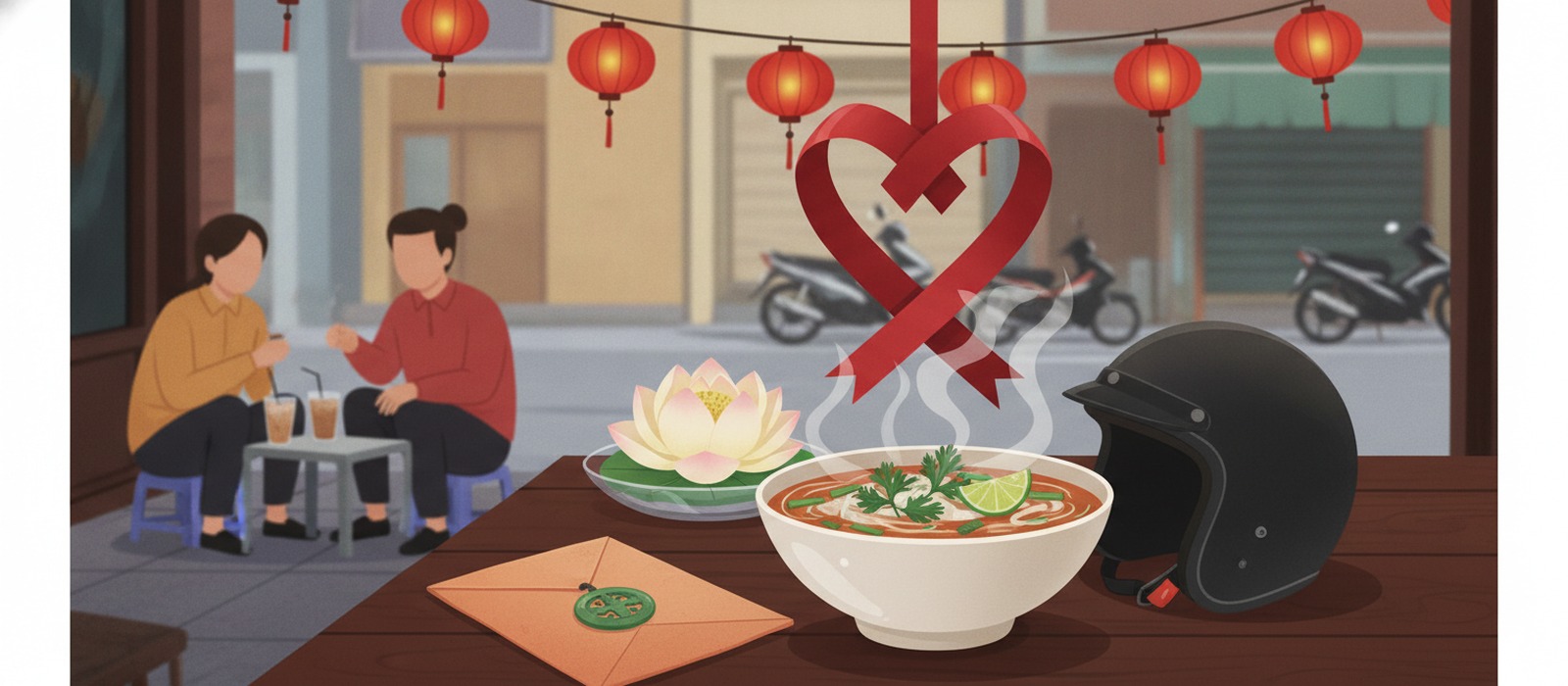
Vietnamese dating culture runs on a different clock than dating culture in the West: it moves from first coffee to family introduction faster than most foreign men expect, and it treats a "date" as a statement of intent rather than a casual outing. That difference trips up more foreign men than the language barrier does. Get the pace and the pronouns right, and the rest of this becomes learnable.
- 📌 Dating means something serious here, in Vietnamese dating culture, "date" often implies relationship intent, not casual hanging out.
- 👨👩👧 Family gets a vote early, courtship in Vietnam usually includes her parents long before a Western timeline would.
- 💬 Zalo beats the apps you know, most real conversations move off Tinder and onto Zalo within days.
- 🗣️ One wrong pronoun changes the whole sentence, anh, em, and chị are not interchangeable, and she will notice.
This is not a list of pickup lines. It is what actually happens between the moment you ask and the moment she answers, in Vietnamese, with the pronunciation and the meaning attached so you are not standing there guessing.
What Vietnamese dating culture expects from a foreign man
A first date in Vietnam is rarely just a first date. On the dating channel What The Pho, a Vietnamese woman explains it directly: in the West, a date is "hanging out, getting to know each other," but for Vietnamese people, "date means that you are in a serious relationship." If you ask her out casually the way you would in London or Los Angeles, she may hear a much bigger question than you meant to ask.
That seriousness shows up in three concrete habits. You are expected to pay, at least for the first several dates, though most women will offer to cover their share once trust builds. You are expected to lead, meaning you propose the place and the plan rather than asking her what she wants to do. And you are expected to meet her family sooner than a Western timeline would suggest, often within the first few months if things are going well.
None of this is about dominance. It is about signaling that you are someone worth building a life around, which is the actual question a lot of Vietnamese women are quietly asking on a first date. Duong Global Business Consulting Group's dating video puts it bluntly: paying the bill in front of her parents, even when they insist otherwise, is "a test a lot of parents use to test their girlfriend's boyfriends when they first meet them."
Why does family approval matter so much in Vietnamese dating culture?
Family involvement is not a formality you get through once and forget. According to the relationship guide on Krush, Vietnamese dating culture is "built on strong family ties, deep respect for elders, and cultural traditions that shape how relationships begin and grow," and marrying into a family is described as "a merging of values, background, and sometimes even social standing." Expat.com's Vietnam dating guide notes the same pattern from a different angle: it is common for a friend to join an early date "so everyone feels safe or to meet family early on."
Practically, that means her sister calling during your dinner, her mother asking when she will be home, or her cousin sitting three tables over is not disrespect toward you. It is the family checking that this is going somewhere real.
How to ask her out, moment by moment
Picture the moment before you say anything: you have talked a few times, maybe over coffee at the same place, and she has made eye contact and stayed instead of leaving. That is the window. Not a bar at midnight, not a first exchange of numbers.
The line to use is Anh mời em đi uống cà phê được không? (roughly "an moy em oo-ong ka-feh duh-uk khom"), which means "Can I take you out for coffee?" This assumes you are a man speaking to a woman younger than you, which is why it opens with anh, not tôi. Using tôi here reads as cold and formal, closer to a stranger filling out a form than a man asking a woman out.
If she is visibly older than you or holds a position of seniority, the sentence changes to Anh mời chị đi uống cà phê được không?, swapping em for chị. Getting this pronoun wrong is not a small slip. Vietflirt's own editorial line treats pronoun errors as costlier than a rough accent, because the wrong pronoun can either flatten the tone into something oddly formal or, worse, sound presumptuous about a relationship you have not established.
What pronoun should you actually use with her?
Default to anh for yourself if you are a man addressing a woman close to your age or younger, and em for her. If she is clearly older or more senior, you become em and she becomes chị. This is not optional politeness, it is the grammar of the sentence: Vietnamese barely uses a neutral "you," so the pronoun carries the entire social relationship in a single word. When in doubt, ask her directly how she prefers to be addressed. That question alone signals more care than most foreign men bother to show.
What she is likely to say back, and what it means
An offer without a plan for the answer leaves you exactly where you started: silent on the second line. Vietnamese dating culture gives you a narrow range of realistic replies, and each one tells you something specific.
A clean Dạ, được ạ ("yah, duh-uk ah"), meaning "yes, that works," said with a smile and eye contact, is a genuine yes. It is short because Vietnamese politeness favors brevity over enthusiasm, not because she is unsure.
A softer Để em suy nghĩ đã ("day em swee-ngee dah"), meaning "let me think about it first," is not a no. It is often a real maybe, especially if you have only spoken a handful of times. Vietnamese women, according to the r/VietNam thread from a Singaporean woman dating a Hanoi-born man, frequently move at what she called "a slow burn," and a request for time to think fits that pace rather than breaking it.
A polite Em cảm ơn anh, nhưng em bận ("em kahm un an, nyung em buhn"), meaning "thank you, but I'm busy," delivered without a follow-up suggestion for another time, is a no. Vietnamese communication avoids direct confrontation, so refusal usually arrives wrapped in gratitude and a vague excuse rather than a flat rejection. Treat a polite decline as final and leave cleanly. Pushing after that answer is exactly the kind of insistence Vietnamese dating culture reads as a red flag, not persistence.
How do you tell a soft no from a real maybe?
The difference is in what comes after her sentence, not in the sentence itself. A real maybe usually comes with a reason tied to logistics ("I have work until late") or a counter-suggestion ("maybe next week"). A soft no comes with gratitude and nothing else, no counter-offer, no follow-up question back to you. If she does not ask you anything in return, read that as your answer.
Dating apps, Zalo, and where conversations actually happen
Foreign men often start on Tinder or Bumble because that is what they know, and Expat.com's Vietnam guide confirms both apps are active in the country alongside Badoo and Feeld. But Vietnamese daily communication does not live on those apps. It lives on Zalo, the domestic messaging platform most Vietnamese people already use with their family and coworkers.
A local content creator on the DaNang travel channel Esq Unltd Daily described the shift from app to real conversation directly: once a woman gives out her number, "they're going to want to chat, they were going to want to look at all your social media, do a bit of a background check" before agreeing to meet. That vetting step usually happens on Zalo, not inside the dating app itself.
Moving the conversation to Zalo early is not a formality, it is the actual signal that she is taking you seriously.
| Platform | Who actually uses it | English comfort | Best for |
|---|---|---|---|
| Zalo | Nearly all Vietnamese adults | Low, expect Google Translate | Real conversation after first contact |
| Tinder | Younger, urban, some expats | Moderate to good | First contact in Hanoi or Ho Chi Minh City |
| Bumble | Smaller, urban, English-leaning | Good | Women who want to message first |
| Badoo | Mixed, older user base | Low to moderate | Broader reach outside major cities |
SOURCE : expat.com dating guide, video transcripts cited · MAJ 09/2026
Outside Hanoi and Ho Chi Minh City, the picture shifts further. In DaNang, the same Esq Unltd Daily creator noted that approaching women directly on the street or at a coffee shop "hasn't been very successful," and that apps effectively gatekeep the first contact because of lower trust in unfamiliar foreign men. That regional gap matters: a method that works in Saigon can fall flat in a smaller coastal city, and Vietnamese dating culture is not uniform from north to south.
What happens after the first few dates
If the first date goes well, the pace tends to accelerate rather than settle into a casual rhythm. VnExpress International documented a foreign resident in Ho Chi Minh City whose girlfriend's parents enforced a 9 p.m. curfew, explaining that "girls who stay out late are considered promiscuous and may be judged by their neighbors." That is not an isolated family rule, it reflects a broader pattern in Vietnamese dating culture where a woman's reputation is treated as a shared family concern, not a private matter.
Physical affection follows the same conservative logic. Public kissing draws unwanted attention in most of Vietnam, and Duong Global Business Consulting Group's video is explicit that visible discomfort from your girlfriend in public over hand-holding or hugging is a real signal, not shyness to push past. Save anything beyond hand-holding for private settings. This restraint is not repression, it is a different boundary line, and crossing it in public costs you social capital you will not get back easily.
The r/VietNam thread from a foreign man dating a Vietnamese single mother captured a related pattern worth naming honestly: her sister calling repeatedly during their time together, which he initially read as disrespectful, turned out to be ordinary in a culture where family stays in near-constant contact. According to family-centered courtship patterns documented in comparative research from the OECD's social and welfare statistics program, close, ongoing family involvement in personal relationships is a well-established feature across East and Southeast Asia, not a quirk specific to one household.
Frequently asked questions
Is Vietnamese dating culture the same in Hanoi, Ho Chi Minh City, and smaller cities?
No. Hanoi and Ho Chi Minh City have more exposure to Western dating norms, more English speakers, and a faster pace on dating apps. Smaller cities and towns, including DaNang, tend to be more conservative, rely more heavily on apps for a first introduction, and move slower toward physical affection or informal meetings.
Do Vietnamese women expect the man to pay for every date?
Usually yes for the first several dates, though this softens over time. Duong Global Business Consulting Group's guide notes two common exceptions: women who studied or lived abroad often split costs by choice, and women who are financially established themselves may insist on paying without it being a test of your stability.
What does it mean if she wants to check my phone?
In many Vietnamese relationships, shared access to phones and passwords is treated as normal transparency rather than control, according to the mistakes covered in Duong Global Business Consulting Group's video. It is worth discussing your own boundaries directly rather than assuming she means to invade your privacy, since the concept of privacy in a relationship is understood differently here than in most Western contexts.
Why does she keep texting me every day even when we just met?
Frequent contact is a primary way affection gets expressed in Vietnamese dating culture, not a sign of insecurity or control. A Vietnamese woman interviewed on What The Pho described it as wanting "to show they are thinking about you," and treating that pattern as clinginess, rather than the local language of care, is one of the fastest ways to create unnecessary friction early on.
Is Zalo mandatory, or can I stick to Tinder and Bumble?
You can start on Tinder or Bumble, especially in Hanoi or Ho Chi Minh City, but expect the real relationship to move onto Zalo quickly. It is the platform her family and friends already use, and staying only on a dating app past the first few messages can read as keeping her at arm's length.
Sources
- 8 Things You Need to Know Before Dating a Vietnamese Girl — Viet Kieu Dating
- Vietnamese Reacts to You Know You're Dating a Vietnamese Woman When... | Dating Beyond Borders — What The Pho
- Dating a Vietnamese Girl (7 Mistakes You SHOULD Avoid)! — Duong Global Business Consulting Group
- Dating & Girls in DaNang Vietnam - My Experience — Esq Unltd Daily
- The dos and don'ts of dating in Vietnam - Vietnam Guide — expat.com
- Foreign men's culture shock when dating in Vietnam — e.vnexpress.net
- Vietnamese Dating Culture: Family, Tradition, and Diaspora Shifts — krushdating.co
- Question on Vietnamese dating culture — r/VietNam
- My Vietnamese girlfriend is constantly called by her sister during our dates — is this normal? — r/VietNam