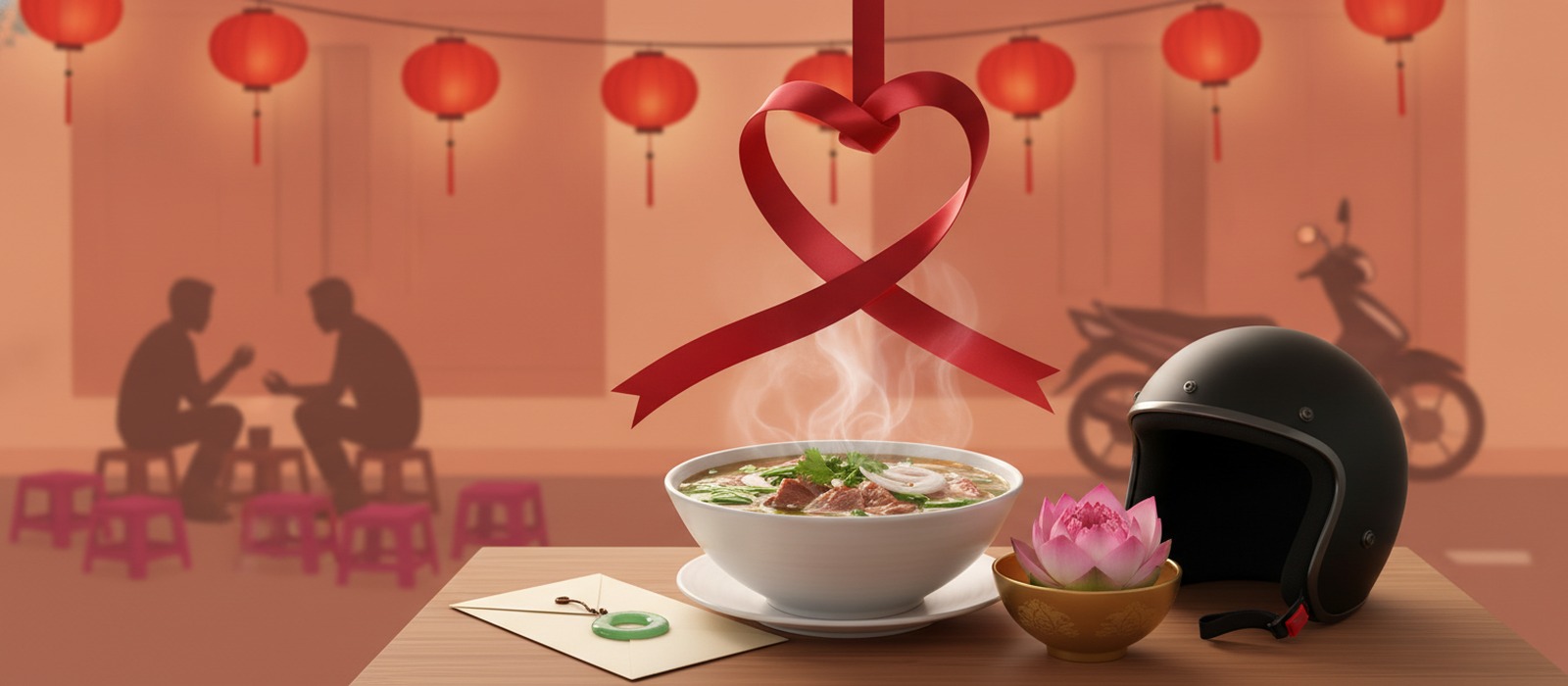
Vietnamese dating culture rewards men who slow down and pay attention to small signals more than it rewards men who talk a lot. A woman who lets you plan the date, a sister who calls three times in an hour, a reply that says "let me think about it" instead of yes or no: none of that is random. Each one is a signal with a specific meaning, and getting it wrong costs you the next date, not just this one.
- 📈 He decides, she confirms, most Vietnamese women expect the man to propose where, what, and when on early dates.
- 💰 Paying isn't optional early on, expect to cover the first few dates; a woman offering to split is a signal worth noticing.
- 👪 Family is on the call, literally, a sister phoning mid-date or a 9 p.m. curfew is normal, not a red flag.
- 🗣️ "Maybe" has its own vocabulary, phrases like "để em xem đã" mean stall, not yes, and mean something different from a flat no.
This guide walks through five things that decide whether a first coffee turns into a second one: who pays and who leads, which pronoun to use before you say anything else, how family shows up even when she's alone with you, what her actual replies mean, and where people are really meeting each other now that street approaches barely work. For the wider picture beyond these five moments, our full Vietnamese dating culture guide covers the rest.
Money, Leading, and the Two Rules Everyone Learns the Hard Way
Vietnamese dating culture puts the man in charge of the first few decisions, and it puts the bill in his hands too. On YouTube, the channel Viet Kieu Dating breaks this down bluntly: most Vietnamese women expect the man to pay for at least the first several dates, though a woman who genuinely likes you will usually offer to cover her share of food or drinks after that point. A woman who never offers, even after multiple dates, is a pattern worth noticing rather than a personality flaw to excuse.
Leading works the same way. Duong Global Business Consulting Group's channel and the couple interviewed on The Evan Eh Show both make the same point independently: asking "where do you want to go, what do you want to eat" reads as weak, not respectful. She expects you to propose a plan and stay open to her input, not to outsource every decision back to her. Evan's friend Michael, who has dated in Ho Chi Minh City for years, puts it directly: never ask a Vietnamese woman what to do the first time you meet her.
Why does she expect you to decide where you're going?
The expectation comes from a broader idea of what a man's role is in a relationship, not from a wish to be controlled. Both the Viet Kieu Dating and Duong Global videos frame indecisiveness as something that kills attraction rather than something that reads as considerate. A gentleman gesture matters more here than in a lot of Western dating contexts: opening a door, offering your jacket when the air conditioning in a cinema is too aggressive, walking her motorbike out of a parking row. None of that replaces leading; it sits alongside it.
There are exceptions worth naming. Duong Global's legal assistant Mi Huan notes that a woman who studied or lived abroad, or a woman who is financially established herself, may set no expectation that you pay for everything. That single distinction changes the whole calculation, so read the person in front of you, not a rule that applies to everyone equally.
Anh, Em, Chị: The Pronoun You Pick Before You Say Anything Else
Vietnamese has no single word for "you." Every sentence you say to her carries a pronoun that states, out loud, how you see the age gap between you, and picking the wrong one is a bigger mistake than a rough accent. Anh is what a man calls himself when he is older than the woman, or what she calls him if he is older. Em is what a man calls himself if he is younger, or what he calls her if she is younger than him. Chị addresses a woman clearly older than you when "em" would sound disrespectful. Mình is reserved for people already close, a couple or old friends, and using it too early sounds presumptuous.
Picture the moment: you've been chatting for two weeks and you want to ask her for a coffee in person rather than through Zalo. If you're the older one in the pair, you say "Em có muốn đi uống cà phê không?" (meaning: "Do you want to go get a coffee?"), pronounced roughly "em kaw mun dee oo-uhng kah-feh khohng." You call yourself "anh" without saying it and you call her "em." If she's older than you, swap the pronouns: you become "em," she becomes "chị" or "anh" depending on how she frames herself, and the sentence structure adjusts around that.
Which pronoun do you use when you don't know her age?
When you genuinely can't tell, ask directly, in Vietnamese if you can manage it, rather than guessing and risking an insult. Vietnamese speakers ask each other's age far more openly than most Western cultures find comfortable, precisely because the pronoun depends on it. Getting the pronoun wrong once is forgivable; refusing to adjust once you know better is not.
Family Comes Along, Even When She's Not There
Vietnamese dating culture treats family involvement as a constant background presence, not an occasional interruption. On r/VietNam, one poster describes his Vietnamese girlfriend's sister calling repeatedly during an entire visit, "while driving, eating, shopping, or in the hotel," and being told this is simply normal here rather than a boundary problem to raise later. VnExpress International reports a similar pattern from a different angle: a foreign man in Ho Chi Minh City named Joe, quoted by reporters Thanh Nga and Quynh Nguyen in August 2024, describes his girlfriend's parents enforcing a 9 p.m. curfew and calling repeatedly to confirm she was on her way home, because staying out late can get a woman judged by neighbors as promiscuous.
This connects directly to something Krush's coverage of Vietnamese dating culture spells out: dating in Vietnam is rarely framed as two individuals; it's framed as two families meeting through two people. Parents may take an active role from early on, offering advice or arranging introductions, and even young Vietnamese who date freely often still discuss the relationship with family or feel a duty to seek approval before things get serious.
What does it mean when her sister calls during your date?
It usually means the family is checking in the way any close-knit family checks in, not that something is wrong with your date or with her feelings toward you. If you eventually meet her parents and want to ask for their blessing to take her out, the moment calls for humility rather than confidence: you address them as an elder would expect, using "con" (child) to refer to yourself. A full sentence sounds like "Con muốn xin phép được đưa [her name] đi chơi" (meaning: "I'd like to ask your permission to take [her name] out"), pronounced roughly "kon mun sin fehp duh-uhk duh-a [name] dee choy." Getting this stage right earns you more credibility than any gift you could bring.
What She Actually Says Back, and What Each Answer Means
A reply is where most foreign men lose the thread, because a polite Vietnamese "no" rarely sounds like the word no. Picture this moment: you've asked her out for the second time and she hesitates instead of answering straight away. She might say "Từ từ đã" (meaning: "slow down, not yet"), pronounced roughly "tuh tuh dah." That's not a rejection; it's a request to pace things, and Duong Global's video is explicit that Vietnamese women rushing into physical intimacy or fast commitment is closer to myth than pattern, so slowing down is often exactly what building trust looks like here.
A softer stall sounds different. If you ask whether she wants to meet your friends this weekend and she answers "Để em xem đã" (meaning: "let me think about it"), pronounced roughly "day em sem dah," treat it as a genuine maybe rather than a disguised no. It usually means she needs to check her schedule, her family's plans, or simply wants a day before committing. Following up once, two or three days later, reads as patient. Following up the same evening reads as pressure.
How do you tell a soft no from a maybe?
The clearest refusal sounds almost casual: "Thôi anh" (meaning: "that's enough" or "no, stop"), pronounced roughly "toy ang." Note the pronoun here comes from her side: she calls you "anh" while calling herself implicitly "em," even in the act of turning you down, because the address terms don't disappear just because the answer is no. A clean "thôi anh" deserves a clean exit, not a second attempt at the same question. Treating a polite refusal as a puzzle to solve rather than an answer to respect is exactly the pattern that turns a single awkward moment into a story she tells her friends.
Dating Apps, Zalo, and Why the Street Approach Rarely Works Anymore
Street approaches, gyms, and coffee shops used to be the default, and in cities like Da Nang they still barely work. LJ Essire, who has lived and dated in Da Nang, describes approaching women in public as largely unsuccessful there because of shyness and a lack of trust toward unfamiliar foreign men; even getting a phone number tends to trigger a background check through social media before a meeting happens at all. Expat.com's Vietnam guide confirms the shift toward apps, listing Tinder, Bumble, Badoo, and Feeld as the most active platforms in the country's dating scene.
Zalo sits differently in this picture. It's Vietnam's dominant local messaging app, and once a conversation moves off Tinder or Bumble, it almost always continues there, because that's where she already talks to family and friends. Moving a conversation to Zalo is a small trust signal in itself: it means she's willing to let you into the same app she uses for everyone she actually knows.
Should you approach her on the street or message first?
In Ho Chi Minh City and Hanoi, apps remain the more reliable entry point, but the two cities are not identical. Hanoi's dating culture leans more conservative and slower-moving than Ho Chi Minh City's, a difference several posters on r/VietNam raise when comparing notes across the north and south, and Da Nang sits closer to Hanoi's pace than to the capital of the south. One American expat's AMA on r/DaNang underlines how much local knowledge changes outcomes: he describes dating multiple local women at once and answering community questions about who should split the bill and what to say on a first date, precisely because those basics are where most foreign men stumble first.
| Approach | Where it's common | What actually happens | Best opening move |
|---|---|---|---|
| Street or coffee shop | Ho Chi Minh City centre, tourist areas | Low success rate; treated with caution by locals | A short, direct question, not small talk |
| Dating apps (Tinder, Bumble) | Ho Chi Minh City, Hanoi | Standard entry point; expect background checks via social media | Move to a real conversation within a few messages |
| Zalo (after matching elsewhere) | Everywhere, once trust is established | Becomes the main channel; signals she's letting you closer | Keep messages short and consistent, not constant |
| Gym, class, shared activity | Da Nang, smaller cities | Slow but genuine; requires patience over weeks | Consistency, not a single strong first impression |
SOURCE: YouTube transcripts (Viet Kieu Dating, Esq Unltd Daily) and expat.com · UPDATED 09/2026
Family expectations around courtship in Vietnam sit inside a wider regional pattern the World Economic Forum tracks in its ongoing research on gender and economic participation across Asia, where family-centred courtship norms are shifting fastest in economies where women's workforce participation keeps rising, as covered in the WEF's gender gap research. Vietnam's own dating culture is moving in that same direction: still family-anchored, but visibly less rigid in cities than in the countryside.
None of this works as a script you memorize once and reuse on every woman you meet. The five things that decide a first date, who pays, who leads, which pronoun fits, how family shows up, and what her actual reply means, all depend on paying attention to the specific person in front of you. A refusal handled cleanly, using basic Vietnamese phrases instead of guessing, keeps the door open somewhere else next week. Getting the pronoun and the pacing right the first time is what turns one coffee into a second one, and if things do get serious, knowing how to say I love you in Vietnamese without misreading who's listening matters just as much.
FAQ
Is it normal for a Vietnamese woman to expect the man to pay for dates?
Yes, especially in the first few dates. Multiple sources, including the Viet Kieu Dating and Duong Global Business Consulting Group channels, describe this as standard rather than exploitative, though a woman who values independence will usually start offering to cover her own share once the relationship is established. A woman who never offers after many dates is a pattern worth paying attention to, not proof that all Vietnamese women expect this.
Why does my Vietnamese girlfriend's family call so often during our time together?
Close, frequent contact with siblings and parents is common in Vietnamese family culture and isn't a sign that something is wrong between you. A poster on r/VietNam describing a sister calling repeatedly throughout a visit was told directly by his girlfriend that this is simply how her family operates, and other sources confirm family involvement stays present even in serious relationships.
What does it mean if she says "để em xem đã" instead of yes or no?
It means she needs time, not that she's rejecting you. This phrase (pronounced roughly "day em sem dah") translates to "let me think about it" and usually signals she wants to check her schedule or think things through before committing. Following up once after a few days, rather than the same evening, respects the pause she's asking for.
Do I need to learn Vietnamese to date successfully in Vietnam?
No, but a handful of correctly pronounced phrases, used with the right pronoun, go further than fluent English on its own. Several people interviewed across the sources for this guide, including Evan Eh's friend Michael, describe language gaps as one of the biggest sources of miscommunication in relationships, so even partial effort in Vietnamese tends to be noticed and appreciated.
Is dating different in Hanoi compared to Ho Chi Minh City or Da Nang?
Yes. Hanoi and Da Nang both lean more conservative and slower-paced than Ho Chi Minh City, where dating apps and a faster dating rhythm are more established. Posters comparing notes on r/VietNam and the AMA host on r/DaNang both describe this north-south difference as real enough to change how you should approach the first few weeks of dating someone.
Sources
- 8 Things You Need to Know Before Dating a Vietnamese Girl — Viet Kieu Dating
- Dating a Vietnamese Girl (7 Mistakes You SHOULD Avoid)! — Duong Global Business Consulting Group
- What it's REALLY like Dating Vietnamese Women in Ho Chi Minh City, Vietnam? — The Evan Eh! Show
- Dating & Girls in DaNang Vietnam - My Experience — Esq Unltd Daily
- The dos and don'ts of dating in Vietnam — expat.com
- Foreign men's culture shock when dating in Vietnam — e.vnexpress.net
- Vietnamese Dating Culture: Family, Tradition, and Diaspora Shifts — krushdating.co
- Dating Culture as a Mixed race (half English half Caribbean) Man in Hanoi — r/VietNam
- I've dated MANY local Vietnamese women. AMA. — r/DaNang
- My Vietnamese girlfriend is constantly called by her sister during our dates — is this normal? — r/VietNam