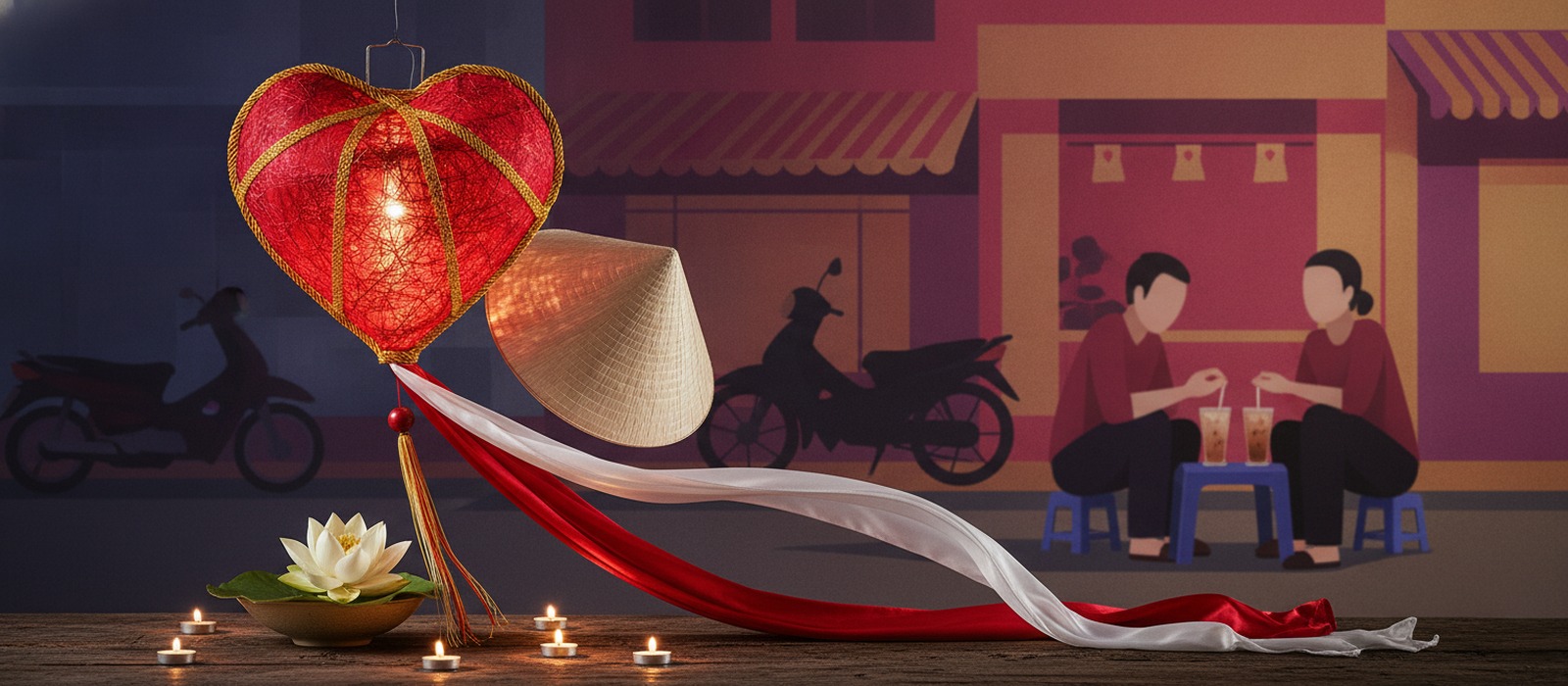
I love you in Vietnamese isn't one phrase, it's a small decision tree. The verb itself is easy: yêu means romantic love, thương covers family and close friends. What changes everything is the pronoun you attach to it, because Vietnamese has no neutral word for "I" or "you." Get the pronoun wrong and you can accidentally tell your girlfriend's mother that she's your girlfriend. This guide walks through the actual sentence for a partner, a parent, and a friend, plus what usually comes back once you've said it.
- 🔑 No single word for love, Vietnamese splits it into yêu (romantic) and thương (family, friends).
- ⚠️ Wrong pronoun, wrong meaning, anh, em, and con carry gender and hierarchy, they're not optional.
- 💡 Silence is an answer too, many Vietnamese partners show love through everyday care, not declarations.
- 🎯 One phrase per relationship, what you say to a girlfriend will sound strange to your mother.
Most phrasebooks hand you Anh yêu em and call it finished. That works if you're a man talking to his girlfriend. It's wrong for almost everyone else you might want to say it to, and Vietnamese speakers notice the mismatch immediately.
The Word for Love Depends on Who Sits Across From You
Vietnamese uses two everyday words that both translate as love: yêu and thương. Yêu is the romantic one, reserved for a partner, boyfriend, or girlfriend. Thương is broader and warmer, used for parents, siblings, grandparents, and close friends, with no romantic weight at all.
Neither word works alone, though. Vietnamese doesn't have a fixed "I" and "you" the way English does. Instead, people address each other with kinship-based terms chosen by relative age, gender, and closeness: anh for an older man or a boyfriend, em for a younger person or a girlfriend, con for yourself when speaking to a parent or grandparent, ba and mẹ for dad and mom. Pick the wrong one and the sentence still means "love," but it points at the wrong relationship entirely.
Why doesn't Vietnamese have a single word for "I"?
Vietnamese pronouns evolved from family titles, so every "I" and "you" also states how the speakers relate to each other, by age and by closeness. That's also part of why the U.S. State Department's Foreign Service Institute ranks Vietnamese as one of its hardest languages for native English speakers: the grammar is simple, but the social calculation behind every pronoun is not. It's a language spoken natively by roughly 86 million people, per Statista's ranking of the world's most-spoken languages, so the pronoun logic isn't a niche quirk, it's the default grammar for tens of millions of daily conversations.
Anh Yêu Em: What to Say to a Girlfriend or Wife
Picture the moment this actually gets used: you've been together a while, you've said it in English already, and you want to say it in her language for the first time, maybe over dinner, maybe in a text late at night.
If you're the man, you say Anh yêu em, pronounced roughly "ahn yew em." Anh refers to yourself, em refers to her, and yêu is the verb. If she's the one saying it to you, the pronouns flip: Em yêu anh, "em yew ahn." That flip is not optional, it's the whole grammar of the sentence.
For extra warmth, howtovietnamese.com notes that Vietnamese speakers often add the partner's name first, followed by à, before the declaration. So if her name is Ly, it becomes "Ly à, anh yêu em." You can also stretch it forward in time with Anh sẽ yêu em mãi mãi, "I will love you forever," or check in beforehand with Anh nhớ em, "I miss you," both drawn from vietnameseexplorer.com.sg's phrase list.
What if you're not sure whether to say anh or em?
The convention is that the older partner uses anh and the younger one uses em, regardless of gender pairing, but couples close in age often settle this by habit rather than by the calendar. Fluentin3months.com puts it simply: follow the terms your partner actually uses with you already, rather than assigning one from a guide.
Con Thương Mẹ: What to Say to Parents, Grandparents, and Family
This one comes up at a different kind of moment: the end of a phone call home, or after a family dinner where her mother has just fed you for the third time and you want to say something back that isn't just "thank you."
In the Pick Up Vietnamese lesson, the phrase for a father is Con thương ba, roughly "cawn tuhng bah," and for a mother it's Con thương mẹ, "cawn tuhng meh." Con means child, the word you use for yourself with any parent or grandparent no matter your actual age. Ba is dad, mẹ is mom, thương is the family verb for love.
Howtovietnamese.com extends the same pattern to grandparents with a different verb, yêu: Con yêu bà for "I love you, grandma," using ông for grandpa instead. Both words are correct here. Thương carries the sound of everyday, unshowy affection, while yêu lands as the bigger, more deliberate declaration. Neither one is a mistake, they just carry different weight.
Tớ Yêu Cậu: What to Say to a Close Friend Without Confusing Them
This is for a friend who has genuinely had your back, someone you want to thank in a bigger way than "cảm ơn," without sending a signal you don't mean to send.
Among close friends, Vietnamese uses a separate, gender-neutral pronoun pair: tớ for "I" and cậu for "you," heard in the Tieng Viet Oi lesson on friendship pronouns. The phrase becomes Tớ yêu cậu, pronounced "tuh yew caw" per fluentin3months.com. There's also a more formal, neutral option, Tôi yêu bạn, "I love you" with the textbook pronouns tôi and bạn, but it reads as stiff and bookish to most native speakers in casual conversation.
Can you say anh yêu em to a female friend?
Grammatically, yes. In practice, almost no one will hear it that way. Anh and em default to couple pronouns in everyday speech, so the same sentence that sounds friendly in English reads as a love confession in Vietnamese. If the relationship is genuinely platonic, tớ and cậu, or thương instead of yêu, keeps the message where you intend it.
Here's the full set side by side, useful as a quick check before you say any of it out loud.
| Who you're talking to | What you say | Rough pronunciation | Meaning |
|---|---|---|---|
| Girlfriend or wife (you're the man) | Anh yêu em | "ahn yew em" | I love you |
| Boyfriend or husband (you're the woman) | Em yêu anh | "em yew ahn" | I love you |
| Mom | Con thương mẹ | "cawn tuhng meh" | I love you, mom |
| Dad | Con thương ba | "cawn tuhng bah" | I love you, dad |
| Close friend | Tớ yêu cậu | "tuh yew caw" | I love you (platonic) |
SOURCE : Pick Up Vietnamese, Tieng Viet Oi, howtovietnamese.com, fluentin3months.com, vietnameseexplorer.com.sg · Updated 09/2026
Other channels covering the same topic, like VietnamesePod101 and HowToVietnamese, pile on romantic compliments beyond the core phrase, telling her she's beautiful, thanking her for staying, calling her your best friend. The vocabulary widens, but the mechanics don't change: it's still yêu or thương, wrapped around the right pronoun for the person you're actually talking to. If you haven't sorted out basic greetings yet, our guide to saying hello in Vietnamese is the logical place to start before this one.
What She's Likely to Say Back, and What It Actually Means
The most direct reply is Em cũng yêu anh, "em cũng yew ahn," adding cũng ("also") to reciprocate in kind. If you hear that, the message landed exactly as sent.
Plenty of Vietnamese partners won't answer in words at all. Vietcetera.com describes Vietnamese affection as something that runs more often through care than through declaration, with a question like "Ăn cơm chưa?" ("Have you eaten yet?") doing the emotional work that "I love you" does in English. Laughter, a change of subject, or a question about whether you've eaten isn't a rejection, it's often the culturally native version of "me too."
A softer, more honest answer is Từ từ đã, "slow down" or "not yet." That's not a no, it's someone telling you the words aren't there for her yet, and asking you to respect the pace. And a clear Mình chỉ là bạn thôi, "we're just friends," is exactly what it sounds like: a clean exit, not a puzzle to solve. Reading that answer correctly, and walking away from it without pushing, is its own skill, separate from getting the pronoun right in the first place. Dating in Vietnam as a foreigner covers what tends to come before this conversation ever starts, and Vietnamese dating culture covers what usually happens after it.
So how do you say I love you in Vietnamese, in one sentence: pick yêu for a partner or thương for family and friends, then match anh, em, con, or tớ to who's actually listening. Get that pairing right and the phrase does its job. Get it wrong and the grammar is fine, but the message lands on the wrong person entirely.
FAQ
What is the most common way to say I love you in Vietnamese?
Between romantic partners, it's Anh yêu em (a man to his girlfriend or wife) or Em yêu anh (a woman to her boyfriend or husband). Both mean "I love you," and the pronouns simply swap depending on who's speaking.
Is there a neutral or gender-free way to say I love you in Vietnamese?
Tôi yêu bạn uses the formal, neutral pronouns tôi and bạn, and works for anyone regardless of relationship. Native speakers rarely use it casually though, since it sounds closer to a textbook line than something you'd say out loud to someone you love.
What's the difference between yêu and thương?
Yêu is specifically romantic love, used for a partner. Thương is warmer and everyday, used for parents, grandparents, siblings, and close friends without any romantic meaning. Vietnamese speakers sometimes use yêu for family too, when the moment calls for a bigger declaration.
Can I say anh yêu em to a friend as a joke?
It's better not to. Anh and em are the default couple pronouns in everyday Vietnamese, so the sentence reads as a genuine romantic confession even when you mean it as a joke. Use tớ and cậu, or thương, if the relationship is platonic.
What if she doesn't say it back right away?
Silence, a laugh, or a change of subject doesn't automatically mean no. Vietnamese affection often shows up through everyday care rather than matching words, and a soft answer like "từ từ đã" (slow down) is a request for time, not a rejection.
Sources
- Lesson 13: How to say I LOVE YOU IN VIETNAMESE - Pick Up Vietnamese
- Learn Vietnamese with TVO | "I love you" in Vietnamese — Tieng Viet Oi
- Cute & Romantic Phrases in Vietnamese — VietnamesePod101.com
- How To Say I LOVE YOU in Vietnamese | Learn Vietnamese Basics — HowToVietnamese
- How to say "I love you" in Vietnamese to a Partner/Friend/Family — howtovietnamese.com
- 35 Ways To Say I Love You In Vietnamese — fluentin3months.com
- How Vietnamese Say "I Love You" Without Saying It — vietcetera.com
- How to Say I Love You in Vietnamese: 16 Ways to Express Love to Loved Ones — vietnameseexplorer.com.sg